Convert battery capacity in mAh to Wh
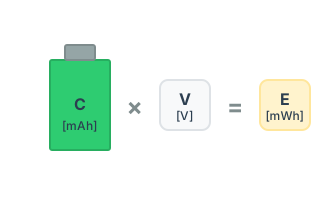
Convert the discharge capacity printed on a battery in mAh into energy in Wh (watt-hours). By convention the reference voltage is usually taken as 3.7 V.
History
Formula
Energy in joules: E[J] = E[Wh] × 3600
Run time[h] = E[Wh] ÷ power drawn[W]
Design notes
Batteries are specified in mAh, but to get a run time out of a power figure in watts you need watt-hours. Wh is also the only fair way to compare batteries at different voltages.
For example: 3.7 V, 2000 mAh = 7.4 Wh, so a 2 W load runs for about 3.7 hours.
Nominal cell voltage depends on the chemistry — 3.7 V for lithium-ion, 3.2 V for LFP (lithium iron phosphate). Use the nominal voltage of your own cell in the conversion.
When you need this
For converting a battery capacity given in mAh into energy in watt-hours. You need this to compare batteries of different voltages, to check against air transport limits, and to estimate run time from a power budget.
Why mAh alone tells you little
mAh is charge — how many amps for how many hours — not energy. Comparing batteries of different voltages by mAh alone leads you astray.
A 3000mAh lithium-ion cell (3.7V) holds 11.1Wh; a 3000mAh nickel-metal-hydride cell (1.2V) holds only 3.6Wh. The same mAh, a factor of three apart. The "10000mAh" on a power bank is likewise referenced to the internal cell voltage of 3.7V, so what you can draw at 5V is less again after conversion losses.
Nominal voltages
| Chemistry | Nominal voltage | Energy at 3000mAh |
|---|---|---|
| Lithium-ion / polymer | 3.6 – 3.7 V | about 10.8 – 11.1 Wh |
| Lithium iron phosphate (LiFePO₄) | 3.2 V | about 9.6 Wh |
| Nickel-metal-hydride (NiMH) | 1.2 V | about 3.6 Wh |
| Alkaline | 1.5 V | about 4.5 Wh |
| Coin cell (CR2032) | 3.0 V | about 9.0 Wh (capacity is only ~220mAh) |
| Lead-acid | 2.0 V per cell | about 6.0 Wh |
Nominal voltage is an average over the discharge. Lithium-ion runs from 4.2V down to about 3.0V, so the energy actually available is the integral of the discharge curve; using nominal voltage approximates it.
Air transport limits
Lithium battery air transport is regulated in watt-hours. Carry-on is unrestricted up to 100Wh, requires airline approval from 100 to 160Wh, and is generally prohibited on passenger aircraft above 160Wh. This is why power banks must be marked in Wh.
Shipping a product with lithium cells inside also requires UN38.3 testing plus correct marking and packaging. Confirm this early in the design.
Common mistakes
- Treating power bank capacity as deliverable output. A 10000mAh (3.7V = 37Wh) pack delivers about 31Wh at 5V assuming 85% boost efficiency, which is roughly 6300mAh at 5V. Around 60% of the printed number is realistic.
- Ignoring low-temperature loss. Lithium-ion delivers around 80% of capacity at 0°C and roughly 50% at −20°C. For outdoor equipment this is decisive.
- Ignoring discharge rate. Rated capacity applies at a specified current such as 0.2C. Discharging harder loses capacity to internal resistance.
Frequently asked questions
How do Wh and joules relate?
How do I estimate run time?
Why does a power bank deliver less than its rating?
Standards and references
- UN38.3 — Transport test requirements for lithium batteries.
- IATA Dangerous Goods Regulations — Watt-hour categories for air transport.
- IEC 61960 — Performance specification for portable lithium secondary cells.
Last updated: 2026-08-29