Power consumption from current and voltage
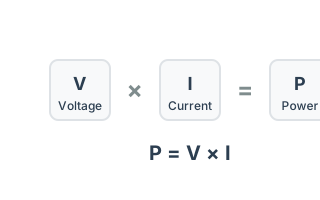
Power consumption from current and voltage Work out the power drawn from the current, the voltage and the duty cycle.
History
Formula
(duty runs from 0 to 1.0; use 1.0 for continuous operation)
Design notes
Knowing the power drawn is what lets you size the supply, plan for the heat and work out battery life. For anything that runs intermittently under PWM, the average power — duty included — is the number that matters.
Where it comes up:
• PWM dimming of an LED: at duty 0.5 the power halves
• Battery design: back out the run time from the average power
• Deciding on supply wattage and whether a heatsink is needed
When you need this
For sizing a supply, or working out the average power of intermittently active equipment. The duty factor lets you express things like "3mA all the time, 120mA while transmitting 5% of the time" directly.
Using the duty factor
Duty runs from 0 to 1.0 and is the fraction of time that current flows. Continuous is 1.0; 10% of the time is 0.1.
For equipment whose current differs greatly between modes — radios, sensors — calculate each mode separately and sum. Sleep current has a duty close to 1.0, so even a small figure dominates over a year.
Worked example: a LoRa sensor node
| Mode | Current | Duty | Average |
|---|---|---|---|
| Sleep | 5 µA | 0.9995 | about 5 µA |
| Sensor read | 8 mA | 0.0003 | about 2.4 µA |
| LoRa transmit | 120 mA | 0.0005 | about 60 µA |
| Total | — | — | about 67 µA |
3.3V × 67µA ≈ 0.22mW. On paper a 2000mAh cell lasts over three years. In reality you must add cell self-discharge and regulator quiescent current to the same table. In low-power designs, sleep current and regulator quiescent current almost always dominate.
Sizing the supply
- Do not size on the average. Supply capacity follows peak current. An average of 67µA still draws 120mA during transmission. If the supply cannot deliver it the rail collapses and the device resets. The usual answer is local capacitance (see Capacitor sizing).
- Do not forget efficiency. This is the load-side power. At 85% DC/DC efficiency, the input draws this divided by 0.85 (see Power supply efficiency).
- Calculate per rail. Adding currents across 3.3V, 5V and 1.8V rails is meaningless. Work out power per rail, then sum.
- Treat inrush separately. At start-up, charging capacitance draws many times the steady current. Check that supply protection does not trip.
Frequently asked questions
What if I enter a duty above 1?
How do I calculate battery life?
Does this work for mains equipment?
Standards and references
- IEC 62301 — Measurement of standby power.
Last updated: 2026-08-29