Capacitance for a pulse current
Find the capacitance able to supply a pulse of current. Work out the value needed from the output current, the output voltage and how long the pulse lasts.
SI prefixes accepted (4k7 / 1M / 10m / 220). Upper-case M = mega, lower-case m = milli
History
Formula
In µF: C[µF] = I × t / V × 10⁶
Design notes
A capacitor stores energy and can hand it back as a burst of current. It covers the brief, heavy draws that the supply itself is too slow to follow.
Typical cases:
• The transmit burst of a radio module (a large, very short current)
• Decoupling next to the supply pin, keeping an MCU stable
• Inrush at motor start-up
When you need a lot of capacitance, the usual answer is an electrolytic together with an MLCC: the electrolytic supplies the bulk, and the MLCC covers the high frequencies where the electrolytic's ESL gets in the way.
When you need this
For sizing a capacitor to keep a circuit alive after the supply drops (hold-up), or to supply a burst of load current locally. Typical cases are surviving a brownout, completing a shutdown routine, and absorbing motor or relay inrush.
What is calculated
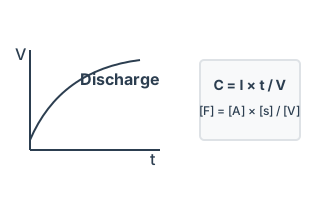
C = I × t / ΔV. Supplying current I for time t causes the voltage to sag by ΔV; this inverts that relationship to give the capacitance.
The "output voltage" field is the permissible voltage drop ΔV, not the supply voltage. If 5V may sag to 4.5V, enter 0.5. Getting this wrong is an order-of-magnitude error.
You could work from E = ½CV², but in practice it is more natural to start from how far the rail may sag. That limit comes from the dropout voltage of the downstream regulator or the brown-out threshold of the microcontroller.
Worked example: completing a shutdown after power loss
- A 5V-input product. After power is removed, saving to flash takes 10ms.
- Consumption during that window is 200mA.
- The downstream 3.3V regulator has 0.5V of dropout, so 5V may fall to 3.8V. ΔV = 1.2V.
- Entering 0.2A / 1.2V / 10ms gives 1667µF.
- Allowing for electrolytic tolerance (−20%), ageing and low-temperature loss, fit 2200µF or more.
What gets overlooked
- Instantaneous drop from ESR. A capacitor is not an ideal source. 0.1Ω of ESR at 200mA loses 20mV immediately. For current pulses, ESR can matter more than capacitance.
- Electrolytics lose capacitance with temperature and age. Expect 60–80% of the room-temperature value at −25°C, with a further 20% loss by end of life. Equipment running cold often needs close to double the capacitance.
- Ceramic DC bias derating. High-permittivity types (X5R / X7R) lose capacitance under bias — some halve at half rated voltage. If you use ceramics for hold-up, calculate with the effective value.
- You need a blocking diode. If the supply collapses to a short, the stored charge flows back into it. Without a diode you cannot deliver it to the load — and the diode's forward drop reduces your usable range.
Frequently asked questions
What goes in the "output voltage" field?
Electrolytic or ceramic?
Can I use a supercapacitor?
How do I deal with inrush?
Standards and references
- IEC 60384-4 — Aluminium electrolytic capacitor specification.
- IEC 60384-21/22 — Multilayer ceramic capacitor specification.
Last updated: 2026-08-29