Electricity cost from rated power
Work out the electricity cost from the rated power consumption in watts. Enter the hours of use per day and your price per kWh to get the cost per day, month and year.
History
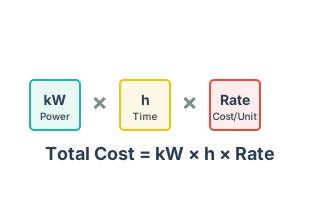
Formula
Per month: cost per day × 31
Per year: cost per day × 365
Design notes
Turn a device's power consumption into money. Useful for showing what a low-power design actually saves, and for quoting running cost on a product.
For reference, typical residential prices per kWh:
• United States: about $0.17 (national average)
• United Kingdom: about £0.25
• Germany: about €0.35
Enter your own tariff to match your bill. On IoT products it is common to put the yearly energy cost in front of the customer — a saving expressed in currency lands better than one expressed in milliwatts.
When you need this
For working out the running cost of standby power or continuously operating equipment. Expressing "one watt of standby costs this much per year" makes it easy to weigh against the bill of materials.
Entering values
- Cost per kWh varies by country and tariff. As a reference point, Japanese domestic supply is around 31 yen/kWh including fuel adjustment and renewable levies. Deriving your own effective rate from a bill is more reliable.
- The monthly figure uses 31 days.
- Rated power should be the actual consumption. Nameplate ratings are usually maxima and real consumption is lower.
Standby power reference
| Standby power | Per day | Per month | Per year |
|---|---|---|---|
| 0.1 W | about 0.07 | about 2.3 | about 27 |
| 0.5 W | about 0.37 | about 11.5 | about 136 |
| 1 W | about 0.74 | about 23.1 | about 272 |
| 5 W | about 3.7 | about 115 | about 1,358 |
| 20 W | about 14.9 | about 461 | about 5,431 |
The handy rule is one watt costs roughly 270 per year at this tariff. Saving two watts saves about 540 a year — on a high-volume product, a component costing a fraction of that pays for itself.
Design implications
- Look at supply no-load loss. A switching supply consumes power with no load at all, in the controller and transformer magnetising current. That is the first thing to attack for standby.
- Quiescent current of always-on regulators. A 1mA LDO running from 12V is 12mW. The cost is trivial but on battery equipment it is decisive.
- Check regulatory limits. Regimes such as the EU ErP directive cap standby power, making it a design requirement for exported products.
Frequently asked questions
What rate should I use?
Is power factor accounted for?
Why 31 days in a month?
Standards and references
- IEC 62301 — Measurement of standby power.
- EU Regulation 1275/2008 (ErP) — Standby and off-mode power limits.
Last updated: 2026-08-29