PCB weight
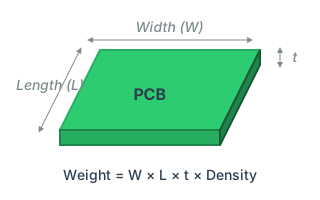
Weight of a printed circuit board. Estimates the mass from the outline dimensions. The glass-epoxy laminate and the copper are shown separately.
Advanced — Density of copper, Density of laminate
History
Formula
Density of copper ≈ 8.95 g/cm³
Density of FR-4 ≈ 1.8 g/cm³
Design notes
On drones, wearables and anything else with a tight mass budget, estimating board weight early is worth doing. The same numbers give you the copper usage for a production cost estimate.
Ways to take weight out:
• Shrink the outline — weight goes with area
• Use a thinner laminate (0.8 mm, say)
• Keep the layer count and copper thickness to the minimum that works
Density of copper ≈ 8.95 g/cm³; density of FR-4 ≈ 1.8–2.0 g/cm³, varying a little between suppliers.
When you need this
For quotations, shipping weight, giving mechanical engineering a figure, or building up a system weight budget. Laminate and copper are reported separately, so on thick-copper multilayer boards you can see which dominates.
Entering the values
- Layer count is the number of copper layers. For a 4-layer board, enter 4 (not the number of cores).
- Copper thickness is per layer. 1oz is 0.035mm. If layers differ, use an average or calculate them separately.
- Laminate density is roughly 1.85–1.95 for FR-4, depending on glass content.
- Copper density can be left at 8.96.
Typical breakdown
| Layers | Laminate | Copper | Total |
|---|---|---|---|
| 2 | about 29 g | about 6 g | about 35 g |
| 4 | about 28 g | about 13 g | about 40 g |
| 6 | about 26 g | about 19 g | about 45 g |
| 8 | about 25 g | about 25 g | about 50 g |
At constant board thickness the laminate contribution barely changes with layer count; the increase is essentially all copper. By 8 layers copper is close to half the total, and more so with 2oz on a power board.
Caveats
- This is the bare board. Components, solder, connectors and shielding cans are not included. An assembled board is commonly 1.5–3 times the bare weight.
- Copper is assumed to cover the full area. In reality, signal layers retain 30–60% after etching. Multiply the copper figure by your CAD tool's copper coverage if you need precision. Plane layers are close to 100%.
- Surface finish is excluded. The weight of gold plating or HASL is normally negligible.
- Cut-outs are not subtracted. For shapes with large openings, substitute the actual area.
Frequently asked questions
How do I account for copper coverage?
What laminate density should I use?
Does this work for aluminium or flexible boards?
Standards and references
- IPC-4101 — Laminate specification and material properties.
- IPC-4562 — Copper foil specification; thickness versus oz.
Last updated: 2026-08-29