Convert dB to ratio
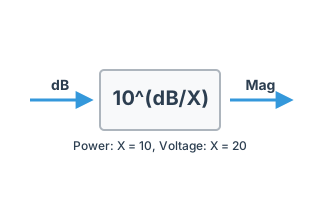
Convert decibels (dB) into a linear ratio. Example: −3 dB = 0.707× (voltage)
History
Formula
Power ratio: ratio = 10^(dB/10)
Example: −3 dB → voltage ratio ≈ 0.707 (= 1/√2), power ratio = 0.5
Design notes
The decibel is a logarithmic unit used for amplifier gain, filter attenuation, antenna gain and much else. Human hearing is logarithmic too, which is why audio work uses the same scale.
Values worth knowing by heart:
• 0 dB → 1× (no change)
• −3 dB → 0.707× in voltage, 0.5× in power — this is the definition of a cutoff frequency
• −6 dB → 0.5× (voltage)
• −20 dB → 0.1× (voltage)
• +6 dB → 2× (voltage)
When you need this
For amplifier gain, filter attenuation, antenna gain and signal-to-noise ratio — working out what a figure quoted in dB actually multiplies by. Voltage and power ratios are shown together so you cannot misread which basis applies.
Voltage and power use different factors
dB is a logarithmic ratio, but power uses 10·log₁₀ and voltage uses 20·log₁₀. Into the same resistance, power goes as the square of voltage, hence the factor of two.
So the same "6dB" means twice the voltage but four times the power. Always establish what quantity a specification is referring to.
Worth memorising
| dB | Voltage ratio | Power ratio | Feel |
|---|---|---|---|
| 1 dB | 1.12 | 1.26 | Just about perceptible |
| 3 dB | 1.41 (√2) | 2.00 | Power doubles / halves |
| 6 dB | 2.00 | 3.98 | Voltage doubles |
| 10 dB | 3.16 | 10.0 | Power up one decade |
| 20 dB | 10.0 | 100 | Voltage up one decade |
| 40 dB | 100 | 10,000 | Voltage up two decades |
| 60 dB | 1,000 | 1,000,000 | Voltage up three decades |
| −3 dB | 0.707 | 0.500 | Filter cutoff |
| −20 dB | 0.1 | 0.01 | Attenuated tenfold |
With "20dB is ten times in voltage" and "6dB is twice in voltage" you can build the rest by addition: 26dB is 10×2 = 20 times, 46dB is 10×10×2 = 200 times.
dB with a reference
| Unit | Reference | Where used |
|---|---|---|
| dBm | 1 mW | RF power. 0dBm = 1mW, 30dBm = 1W |
| dBW | 1 W | High power. 0dBW = 1W = 30dBm |
| dBµV | 1 µV | EMC measurement voltage |
| dBµV/m | 1 µV/m | Radiated emission field strength |
| dBi | Isotropic radiator | Antenna gain |
| dBc | The carrier | Spurious emissions, phase noise |
Frequently asked questions
Is 3dB or 6dB "double"?
How do I convert dBm to watts?
Why is EMC measured in dBµV/m?
What does a negative dB mean?
Standards and references
- IEC 60027-3 — Definition of logarithmic quantities and their units (dB / Np).
- CISPR 16-1-1 — EMC measuring equipment specification; use of dBµV.
Last updated: 2026-08-29