Convert mil to mm
A mil is short for milli-inch: one thousandth of an inch.
History
Formula
Design notes
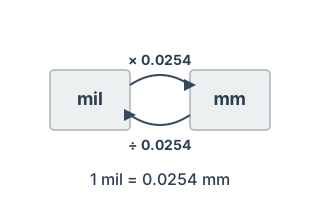
1 mil = 1/1000 inch = 0.0254 mm. The name is a contraction of milli-inch and it is also called a thou. It has nothing to do with the metric prefix milli, so take care not to confuse it with a millimetre.
Schematic and PCB CAD tools default to different units, so this conversion comes up constantly when handing design data over or writing fabrication drawings.
A connector on a "100 mil pitch" is the same as a 2.54 mm pitch.
When you need this
For turning a fabricator's specification or an overseas datasheet quoted in mils into the millimetres your CAD tool uses. Requirements like "4mil minimum trace" or "5mil minimum annular ring" have to become design rules.
Where mils appear in fabrication specs
- Minimum trace width and spacing. Quoted as 4mil, 5mil or 6mil. These form the backbone of your design rules.
- Annular ring. The width of pad remaining outside the drilled hole on one side. Below 5mil (0.127mm) drill registration error risks breaking out of the pad.
- Solder mask clearance. Usually specified as 2–3mil.
- Board thickness. 62mil = 1.6mm, 31mil = 0.8mm, 93mil = 2.4mm are the standard options.
- Copper weight is quoted in oz, not mils — see Copper weight (oz) to thickness.
Conversion table
| mil | mm | What it means on a board |
|---|---|---|
| 3 mil | 0.076 mm | Minimum width/space on dense boards (premium) |
| 4 mil | 0.102 mm | Practical floor for high-density work |
| 5 mil | 0.127 mm | Standard minimum width/space |
| 6 mil | 0.152 mm | Comfortably within cheap fabrication |
| 8 mil | 0.203 mm | Relaxed design |
| 10 mil | 0.254 mm | Ordinary signal trace |
| 20 mil | 0.508 mm | Light power trace |
| 40 mil | 1.016 mm | Power trace |
| 62 mil | 1.575 mm | Standard 1.6mm board thickness |
Fabrication specifications are usually written in mils while the CAD work is in millimetres. Remembering just 5 mil = 0.127mm and 10 mil = 0.254mm covers most situations mentally.
Frequently asked questions
What is annular ring?
How many mils is 1oz copper?
What if a specification uses decimal inches?
Standards and references
- IPC-2221B — Generic PCB design standard.
- IPC-6012 — Board performance specification; annular ring requirements.
Last updated: 2026-08-29