Convert oz to copper thickness
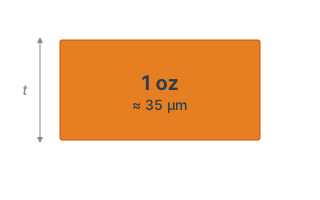
The copper foil on a printed circuit board is often specified by weight in ounces (oz). 1 oz is about 0.035 mm.
History
Formula
1 oz ≈ 35 µm = 0.035 mm
Design notes
In a PCB specification, "1 oz copper" means the thickness you get by spreading one ounce of copper over one square foot, which works out at 35 µm (0.035 mm).
The usual choices:
• 0.5 oz (18 µm): inner layers and fine-pitch work
• 1 oz (35 µm): the standard outer layer for general signals
• 2 oz (70 µm): high-current traces
• 3 oz and above: power boards and supply sections
The thicker the copper, the wider the minimum trace your board house can etch reliably. Check their capability table before committing to a stack-up.
When you need this
For converting the copper weight in your fabricator specification or CAD stack-up from oz to millimetres. Current capacity, impedance and board weight calculations all need the thickness in millimetres.
Why thickness is quoted as a weight
"1oz" means one ounce of copper per square foot — an areal density, not a thickness. It is a historical unit reflecting a process that spread a fixed quantity of copper over a fixed area.
Working from the density of copper gives roughly 34µm, and the nominal figure used in the standards is 1.37mil (about 34.8µm). In practice it is treated as 35µm.
Conversion table
| oz | Thickness | Sheet resistance | Practical min. width | Use |
|---|---|---|---|---|
| 0.5 oz | 17.5 µm | about 0.99 mΩ/sq | 3 mil | Inner signal layers, high density |
| 1 oz | 35 µm | about 0.49 mΩ/sq | 4 mil | The usual default |
| 2 oz | 70 µm | about 0.25 mΩ/sq | 6 mil | Power boards |
| 3 oz | 105 µm | about 0.17 mΩ/sq | 8 mil | High current |
| 4 oz | 140 µm | about 0.12 mΩ/sq | 10 mil | High current (special order) |
Thicker copper means you cannot route as finely. Etching proceeds sideways as well as down, so thicker foil produces a more trapezoidal profile and tighter minimum width and spacing limits. Before settling on 3oz "because of the current", confirm the routing density you need is still achievable.
Cautions
- Inner and outer layers mean different things. Outer layers receive plating on top of the base foil, so the finished copper is thicker than specified. "1oz outer" commonly finishes at 45–60µm. Inner layers are as specified.
- Use the real thickness for impedance. Plated-up outer copper changes impedance. Confirm with your fabricator.
- Heavy copper affects cost and lead time. Above 2oz, fewer fabricators can build it and prices rise. Check first whether widening the trace solves the problem.
- 1/3 oz and 1/2 oz exist too. High-density boards and fine-line work use foil down to around 12µm.
Frequently asked questions
How many µm is 1oz exactly?
What is the actual outer-layer thickness?
Is heavy copper the only way to carry high current?
Does heavy copper help at high frequency?
Standards and references
- IPC-4562 — Copper foil for printed boards; thickness versus oz.
- IPC-2152 — Conductor current capacity; copper weight and width.
- IPC-6012 — Board performance specification; finished copper thickness.
Last updated: 2026-08-29