Convert power ratio to dB
Convert a power ratio (P1 / P2) into decibels (dB).
History
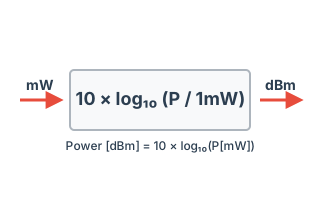
Formula
Note the factor of 10 for power (voltage uses 20)
Design notes
Power ratios use a different factor from voltage ratios (10×log against 20×log). RF design deals in power most of the time, so this is the version you reach for.
Why the factor differs: since P = V²/R, power goes with the square of voltage. Squaring doubles the logarithm, so the multiplier is halved (20 → 10).
When you need this
For expressing a ratio of two powers in dB. Transmit power, cable loss, antenna gain and isolation are all power-referenced, which is the standard basis in RF work.
Power ratios use 10·log₁₀
dB = 10 × log₁₀(P1 / P2). The factor differs from the 20 used for voltage, so mixing them up gives a two-fold error.
In RF, impedances are standardised at 50Ω, which makes working in power natural. Transmit power (dBm), cable loss (dB/m) and antenna gain (dBi) are all power-based.
Using it for a link budget
The convenience of dB is that multiplication becomes addition. Write every element of the path in dB and simply add and subtract to get the received power.
| Item | Value | Running total |
|---|---|---|
| Transmit power | +13 dBm | 13 dBm |
| Transmit cable loss | −1 dB | 12 dBm |
| Transmit antenna gain | +2 dBi | 14 dBm |
| Free-space loss (1km) | −92 dB | −78 dBm |
| Receive antenna gain | +2 dBi | −76 dBm |
| Receive cable loss | −1 dB | −77 dBm |
Against a module sensitivity of −120dBm, the link margin is 43dB. Real deployments add fading from buildings and terrain, so budgeting 20–30dB of margin is normal.
Quick reference
- 3dB is twice, 10dB is ten times. For power, everything can be built from these two.
- 0dBm = 1mW, 30dBm = 1W. With these two anchors you can interpolate in 10dB steps.
- Negative means loss. Cable loss, free-space loss and insertion loss are all negative dB.
Frequently asked questions
What is the difference between dBm and dB?
How do I calculate free-space loss?
Any trick for not confusing this with the voltage form?
Standards and references
- IEC 60027-3 — Definition of logarithmic quantities.
- ITU-R P.525 — Calculation of free-space attenuation.
Last updated: 2026-08-29