Convert voltage ratio to dB
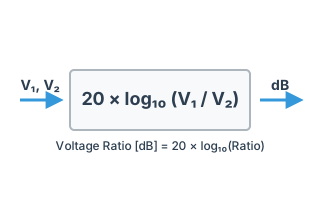
Convert a voltage ratio (V1 / V2) into decibels (dB).
History
Formula
Design notes
Use this to express amplifier gain or circuit loss in dB from measured input and output voltages. With V1 = 2 V and V2 = 1 V you get 20 × log₁₀(2) ≈ 6 dB, which you would describe as "6 dB of gain".
It also converts readings taken straight off an oscilloscope or spectrum analyser.
When you need this
For expressing a ratio of two voltages in dB — amplifier gain, attenuation, signal-to-noise ratio, power supply rejection (PSRR) and crosstalk, all of which are specified as voltage ratios.
Voltage ratios use 20·log₁₀
dB = 20 × log₁₀(V1 / V2). The factor is 20, not the 10 used for power.
Put the output, or the larger quantity, on top and the input or reference underneath. A smaller numerator gives a negative result, representing attenuation.
Where it is used
- Amplifier gain. Output voltage over input voltage. For an inverting stage, Inverting amplifier reports gain and dB together.
- Signal-to-noise ratio. Signal voltage over noise voltage. Audio work expects 90dB or better (about 31,600 times).
- PSRR. Supply ripple over the ripple appearing at the output. LDO datasheets quote 60–80dB; 80dB means supply ripple is reduced ten-thousandfold.
- Crosstalk. Victim voltage over aggressor voltage. −40dB means 1% is leaking across.
- Shielding effectiveness. Voltage without the shield over voltage with it.
Worked example: checking LDO rejection
- A datasheet states PSRR = 70dB at 1kHz.
- Convert with dB to ratio: 70dB is about 3,162 times in voltage.
- With 100mV of ripple on the input, what remains is 100mV ÷ 3,162 ≈ 32µV.
- If the target is under 50µV, that is comfortable. But PSRR varies strongly with frequency, and many LDOs fall to around 20dB by 100kHz.
- Following a switching converter, check PSRR at the switching frequency, not at 1kHz.
Frequently asked questions
My result is negative.
When do I use the power form (10·log) instead?
Does this require equal impedances?
Standards and references
- IEC 60027-3 — Definition of logarithmic quantities.
Last updated: 2026-08-29